
There was a moment during the ICJS Fellowship for Teachers when something finally clicked for me. For years, I had understood the role of public schools as firmly secular spaces. Religion, I believed, was something to be handled carefully, and many of my colleagues would often avoid it altogether. I would teach some Bible stories in context, and that approach felt safe, professional, and aligned with the expectations of public education.
But during one of our sessions, I began to see the tension more clearly. In trying so hard to create a neutral space, we may actually be flattening something essential.
The image that came to me was simple: we are trying to fit a cross, a Star of David, a crescent, the dharmachakra into a square hole. In the process, we don’t make space for those identities. We reshape them until they fit something more comfortable, more neutral, and ultimately less meaningful.
I started to think about how this plays out in schools. We don’t say “Eid.” We might call it a “wellness day.” We don’t name Rosh Hashanah. We just note that school is closed. Winter break becomes detached from Christmas, and in many cases, from any religious meaning at all. The intention is clear: avoid privileging one tradition over another. But the result, I began to realize, is that we risk diminishing all of them.
Before the fellowship, I would have seen this as appropriate, necessary, and safe. But the conversations at ICJS pushed me to reconsider what neutrality really means. Is neutrality the absence of religion? Or is it the presence of many traditions, held with care and respect? And ultimately, can the public school system adjust to celebrate instead of degrade all religious holidays to simply time off.
That shift in thinking began to change how I approached my classroom.
As an 8th grade English teacher, I work with texts that are deeply connected to religious ideas, whether students recognize it or not. When we read Frankenstein, for example, questions of creation, responsibility, and humanity are impossible to separate from religious traditions. In the past, I might have avoided naming those connections directly, worried about crossing a line.
After the fellowship, I tried something different.
Instead of sidestepping those ideas, I invited them into the room: carefully, academically, and with structure. We looked at the Creature not just as a character, but alongside creation narratives from different traditions. We discussed what it means to be “made,” what responsibility a creator has, and how different cultures have wrestled with those same questions.
What struck me most was not controversy, but engagement.
Students who might not usually participate began making connections. Some referenced things they had heard at home or in their communities. Others asked questions that showed a deeper level of thinking. They were not just about the text, but about people and belief systems different from their own. The room didn’t become less neutral. If anything, it became more intellectually honest. I began to see that avoiding religion doesn’t remove it. It just removes the opportunity to understand it.
This doesn’t mean turning my English classroom into a space of religious instruction. The line there still matters. But there is a difference between promoting belief and acknowledging that belief exists, shapes texts, and shapes people. That is where the public school system does not honor the whole person. The fellowship helped me see that distinction more clearly.
Now, when I think about that earlier metaphor—the cross, the star, the crescent, the wagon wheel—I no longer see them as objects that need to be reshaped to fit school. Instead, I see the responsibility shifting back to us as educators. Perhaps it is the space that needs to expand. We should think about the material existence of our students, their learning, their well being, and the nutrition; public school provides that. But, what of their essential selves?
Public schools are one of the few places where students encounter people different from themselves every single day. If we flatten those differences in the name of neutrality, we miss an opportunity. But if we approach them with care, structure, and respect, we can help students build something more difficult and more necessary.
May 2026
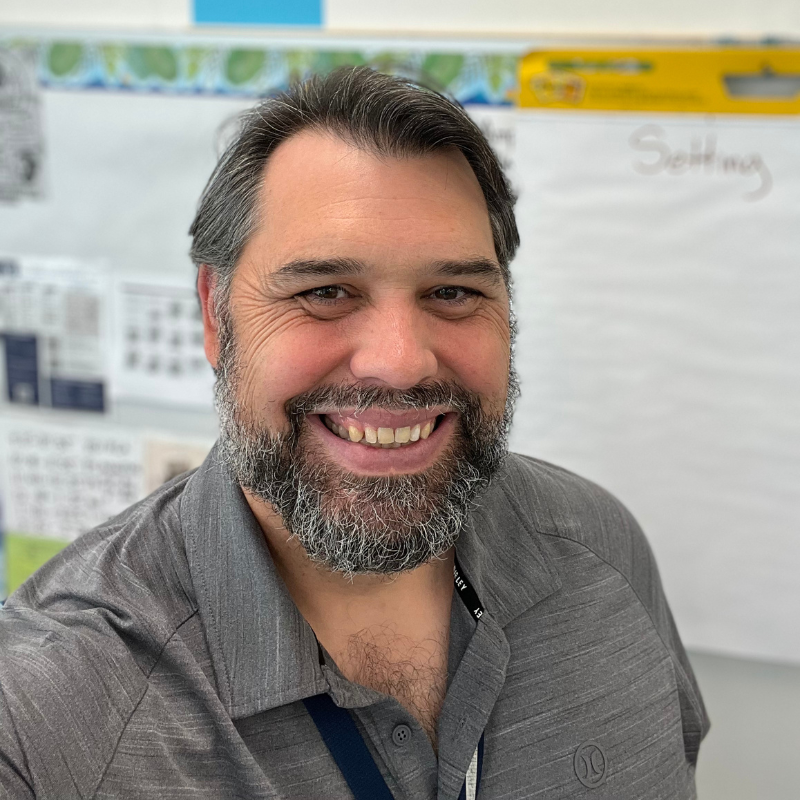
Steven Martinez teaches at Cross Country Elementary Middle School, and was a 2025-2026 ICJS Teachers Fellow. Learn more about the ICJS programs for teachers here.
Opinions expressed in blog posts by the ICJS Teacher Fellows are solely the author’s. ICJS welcomes a diversity of opinions and perspectives.
If you are an educator or know an educator in the Baltimore area who might be interested in learning with us next year, click here.