What does it mean to lead in a society where religious language and symbols are everywhere—but not everyone shares the same faith? For many Christian clergy, that question has become harder to avoid as debates over religious freedom, Christian nationalism, and pluralism increasingly shape public life.
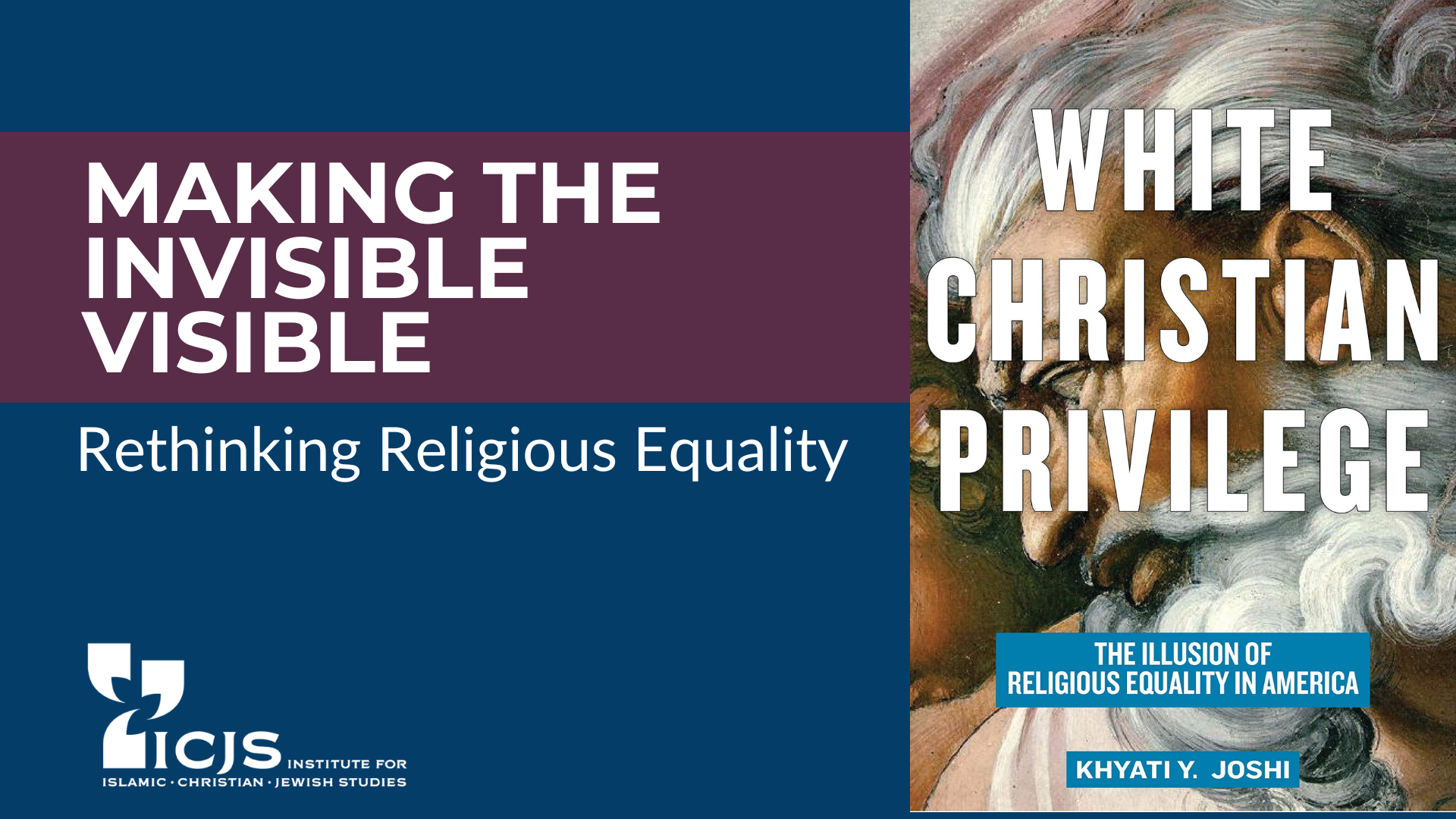
That question sat at the center of a recent clergy book study led by the Rev. Alisha Wimbush, Th.D., ICJS program director for religious leaders, focused on White Christian Privilege: The Illusion of Religious Equality in America, by Khyati Y. Joshi. The study invited pastors and religious leaders to examine not only how Christianity shapes American public culture, but how that shaping quietly advantages some—and marginalizes others.
For Wimbush, the book’s central challenge to Christian leaders is straightforward, but not easy: “The core challenge is really recognizing the privilege.” Because Christian language and symbols are so deeply embedded in American culture, she said, “to tell a Christian clergy, do you recognize that there’s a privilege that you have because you’re Christian—I think that’s hard to swallow.”
Seeing What We Didn’t Have Words For
That challenge was present even for some participants of color. Rev. Alanna Thomas, an AME Zion pastor, said that before the study she had largely collapsed Christian privilege into racial categories.
“Actually, before this group, I probably equated Christian privilege with white privilege,” she reflected. “As a woman of color, I’ve long been aware of the privileges I was denied. As a Christian, I’ve come to recognize the privileges I carried without even realizing it.”
Wimbush described a similar realization in her own journey.
“At first, hearing about me as a woman of color having privilege was hard to digest,” she said. “I said, ‘I’m a woman, I’m a person of color—what type of privilege do I have?’”
What helped her—and others—think differently was understanding religion as a kind of language.
“I am fluent in the language of Christianity,” she explained. “So when I see a cross, when I see the Ten Commandments, I know what that means. And there’s a privilege with understanding that language.”
That fluency, she noted, is not shared by everyone.
“What does it look like to step back and say, people who might not have a particular religious tradition, or might have a different religion—how are they being disadvantaged because they’re not fluent in this particular language?”
The Privilege of the Collar
For some participants, the study also brought new clarity about the forms of authority and access that come with being clergy. Rev. Dominic Holland, a chaplain at Community Regional Medical Center in Fresno, California, named that dynamic directly.
“I’m afforded a whole lot of privilege as a clergy person myself. I acknowledge that,” he said. “Trying to leverage that for the benefit of other people is something I’ve always tried to do. But just kind of recognizing some of the privilege and how it is experienced by other people—I really appreciated that. That was very poignant for me in the study.”
One reason some clergy chose to participate in the book study was they were searching for a community where they could discuss these difficult issues. “They didn’t feel like they had a safe space to say, ‘I wonder why our children aren’t getting off for holidays outside of Christian holidays,’” Wimbush said.
Holland echoed that sense of relief at finding a space for honest reflection.
“I felt the support of a like-minded community to continue to deconstruct and to combat white Christian privilege in my context,” he said.
Another theme that surfaced was fear.
“People feeling like, I’m going to lose something if I give up this privilege,” Wimbush said. “There’s a sense of, I might lose something—and do I want to?”
A Place to Ask Hard Questions
Wimbush believes the book study is already shaping how clergy think about their congregations.
“I have to be mindful of the language I use,” she said, describing participants who began to notice how sermons, prayers, and teaching can unintentionally privilege Christianity or diminish other traditions. “As a leader, what I’m saying—people are taking that in.”
For Holland, the impact was even broader.
“To go through this study gave me a better understanding of how much white Christian privilege has influenced the culture that we are in,” he said, “and how damaging, harmful it can be.”
An Interreligious Lens
Her hope, Wimbush said, is that clergy leave with what she calls “an interreligious lens”—a recognition that “it would be beneficial for me to get to know other religious traditions” and to build relationships beyond one’s own community. “That’s what helps us build a democracy,” she said.
For Wimbush, it is important to acknowledge that Christianity is being used both to justify exclusion and to defend human dignity.
“We’re seeing how Christianity is being weaponized,” she said, “but also how Christianity is being used to live the way I believe Jesus has called us to live, which is to love God and love our neighbors as we love ourselves.”
And for pastors who feel hesitant to engage these questions, Wimbush doesn’t begin with arguments.
“I would be curious,” she said simply. “Why the hesitation? Why the fear? I’d simply ask questions.”