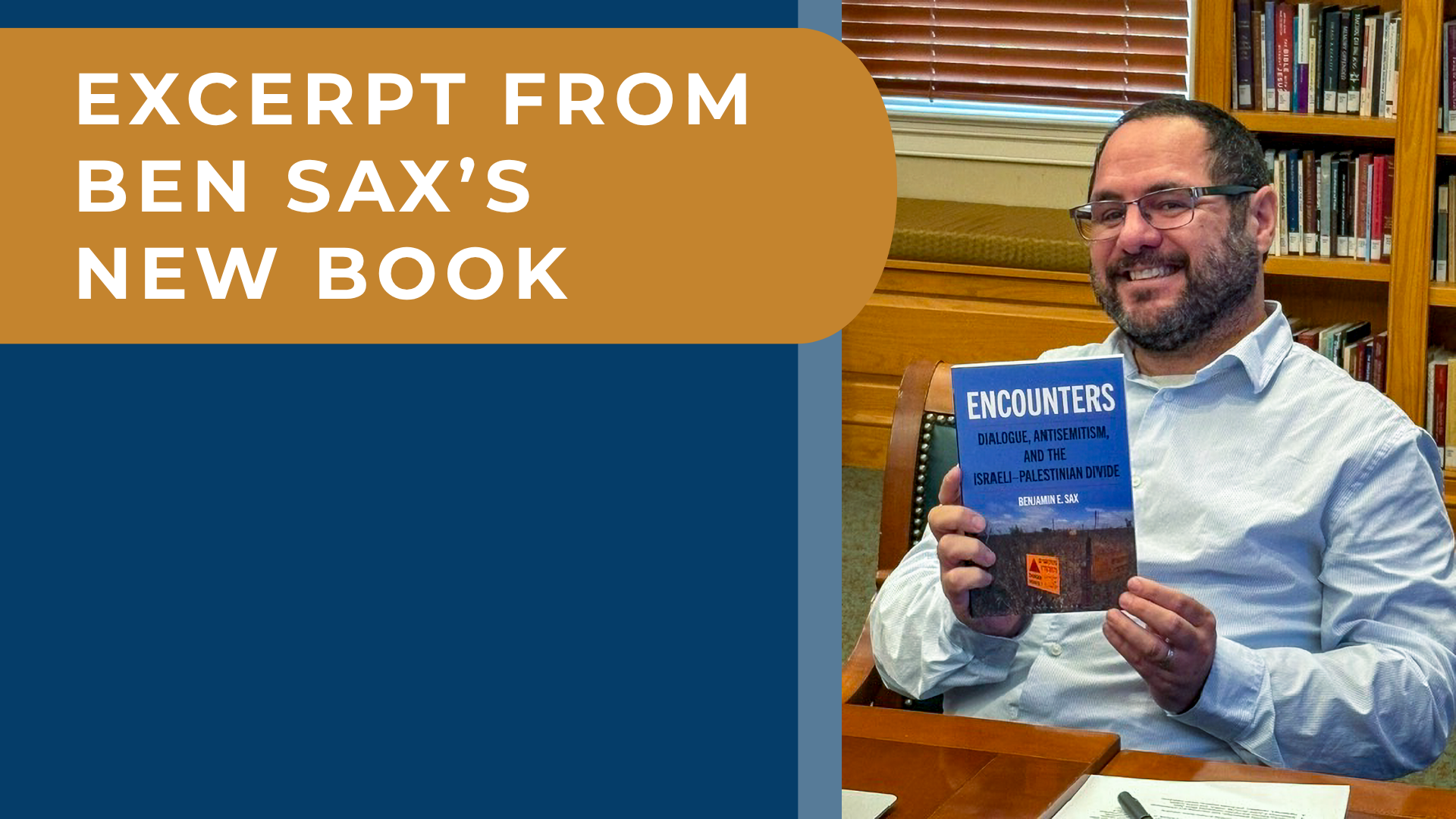
The birth of Benjamin Sax’s first child in a Jerusalem hospital led to what he describes as “an unintentional interreligious encounter.” In this excerpt from Introduction to his new book, Encounters: Dialogue, Antisemitism, and the Israeli–Palestinian Divide, Sax reflects on that experience and its significance.
For a moment during my wife’s labor, I was escorted into a tiny room with two couches, a television, and an oxygen tank. It seemed to be a storage room converted into a small lounge. I forget why I needed to be separated from my wife. Sitting there were two bearded men: one a Haredi Israeli, the other a Palestinian Muslim. A basketball game was on the television. Neither man acknowledged me when I arrived, nor were they interested in one another. It didn’t matter. I was excited. I was about to become a father. I needed to share the news, and I did. Both men congratulated me. They shared that their wives were in labor, too. It was not the first child for either man. We made some small talk and then the conversation took an unexpected turn. One of the men bemoaned the fact that smoking is forbidden in the hospital. “Hospitals,” I was told, “are incredibly stressful places, so, why on earth would smoking not be permitted?” The other man nodded his head fervently. “It’s uncivilized,” he complained. The other, now nodding as fervently, exclaimed, “it’s common sense.”
I have a background in philosophy, and at that time, I was inclined, eager even, to share this information. I had studied the Scottish tradition of common sense, which informed and influenced the American revolution. Part of my country’s heritage is wrapped up in the idea that there is poignancy in the basic, elementary aspects of life. To be sure, these are still ideals. In the spirit of this philosophical-political tradition, I may have suggested, perhaps too zealously, that smoking there, in that particular room, was a terrible idea, especially given our proximity to an oxygen tank. Common sense, right? One of the men looked to the other and said, “I understand now. He’s American.” The other said he was initially trying to figure out my accent—“Was it Dutch? German?”—but it all made sense now, “Yes. American,” he sighed.
While it was clear that we had fundamentally different understandings of common sense, I wanted to know what made my concerns distinctly “American.” I lived in Jerusalem. We were speaking in Hebrew. They couldn’t immediately discern my identity or accent. Strangely, I was offended. I believed that I hid my American origins well. How dare they presume to know me? “Americans are always trying to tell others how to live their lives,” one of the men griped. “Even in America,” the other chimed in, “they can’t smoke in restaurants, malls, libraries,” he continued, “soon they may not be able to smoke on buses or cars!” Even at that time, the proliferation of misinformation prevented opportunities for genuine dialogue, but their confidence about what made me American just seemed flat out wrong. The United States is too big, too complicated to be rolled up into one adjective: “American.” In fact, this was, as it is now, a fairly empty signifier, at least in terms of culture. We need hyphens in our identities. In fact, we need many of them. I took some comfort in knowing that they had no idea what they were talking about. Turns out, though, this too was a typical American response.
Was the problem them or me? The Israeli-Palestinian conflict is almost a cliché. We often hear about the irreconcilable differences of both peoples. Accusations abound against the other’s culture, values, and society. Picking a side—as if there were only two—is a sign of moral integrity for many, especially in the United States: “I’m pro-Israel.” “I’m pro-Palestinian.” “I’m a Zionist.” “I’m not a Zionist.” Here, though, I was sitting with a Palestinian and an Israeli. And despite being Jewish, speaking Hebrew, having a child born in a hospital in Jerusalem, both men saw me as American and lacking in common sense. I was clearly missing something, yet I was still incredulous. I thought to myself, this is what you can agree on: “smoking in a hospital is civilized?” I guess I had discovered the commonality of two peoples. Angrily and perhaps sarcastically, continuing my thought: “So, this is how peace will be built? On this version of common sense?”
Many years later, I learned that I said the wrong thing that evening.
Both an Israeli and a Palestinian were irritated with my point of view. This was what the Jewish philosopher of dialogue Martin Buber called a “mismeeting” (“Vergegnung”): a moment when people are unable to communicate fully. It happens when a person hears something in a way that wasn’t intended by the speaker. There are so many ways in which we speak past one another that very often mismeetings create a sense of loneliness and even despair. For me, this mismeeting was more than a missed opportunity. I wasn’t prepared to hear their responses. I simply reacted. I didn’t listen. In dialogue, there is always more to the story.
Excerpted from Encounters: Dialogue, Antisemitism, and the Israeli–Palestinian Divide by Benjamin E. Sax (Bloomsbury Academic, 2026). Reproduced with permission of the publisher. All rights reserved.