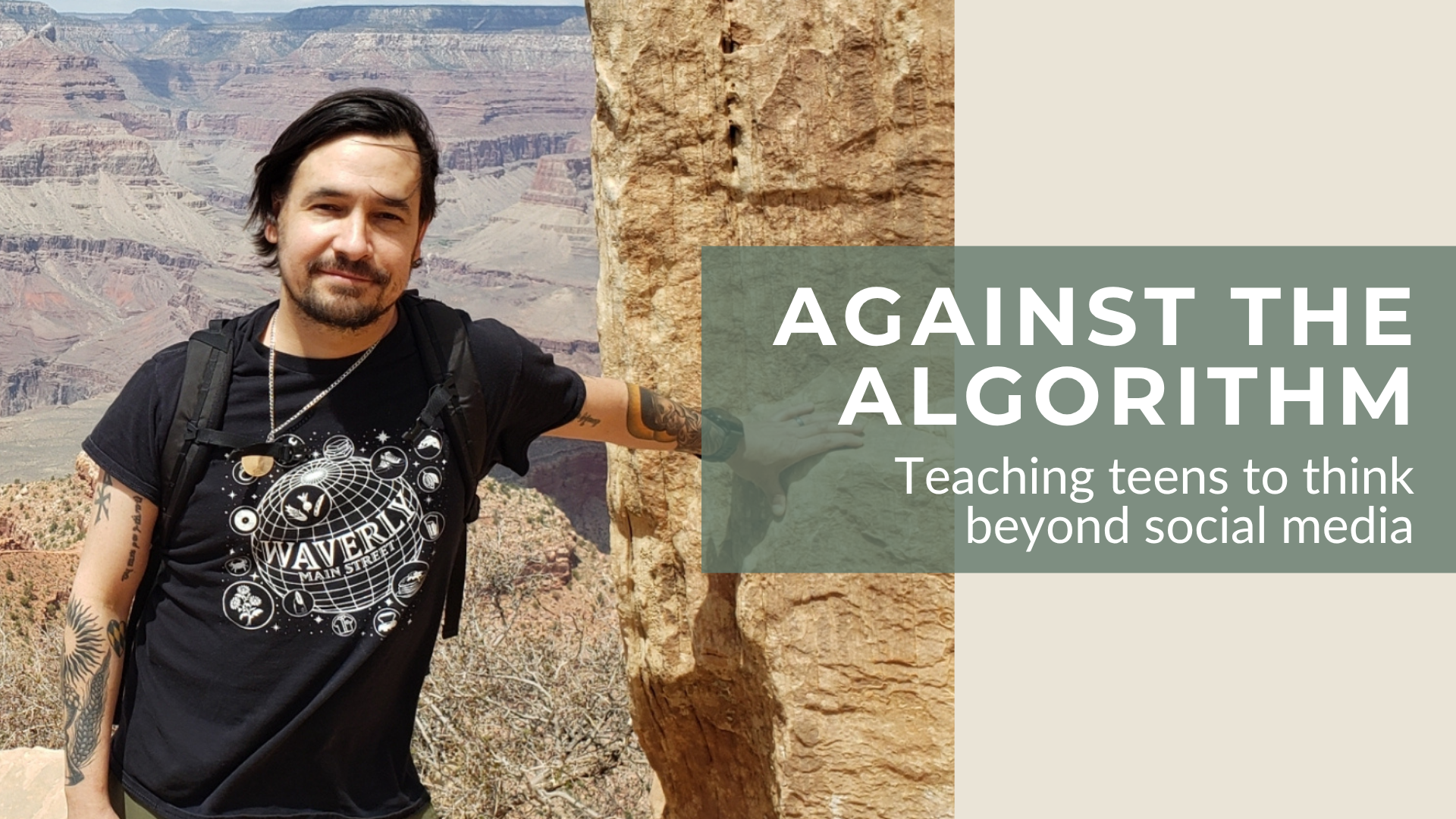
High school teacher Lee Krempel knows that mindfulness is critical when topics that graze religion come up in his classroom. That’s what he found himself navigating in October 2023 after the Hamas attack on Israel launched the still ongoing Gaza War.
It was also only a few weeks into his participation in the ICJS Fellowship for Teachers.
The fellowship “gave me some language on how to step into a thorny topic, especially one that’s emotionally, politically, religiously charged,” said Krempel, who teaches 12th grade English and Advanced Placement Literature at Frederick Douglass High School in West Baltimore.
Krempel says he is strongly influenced by Zen Buddhism and identifies as “a Catholic Christian in a Thomas Merton-Dorothy Day” social justice way. He discovered ICJS when he was searching for a place where he could really dig into “theological and spiritual discussion and study across religions,” he said.
He appreciates the invitation ICJS offers to engage in “the rigor of conversation” with people, both non-religious and religious, “who care about the power of spiritual and religious expression,” he said.
Teaching Teens to Listen—To Each Other
Part of Krempel’s responsibility teaching high school seniors, he said, is “to help them understand how to have an emotionally charged conversation in a better way.”
And because he and his ICJS teacher fellows were wrestling with some of the same questions surrounding Oct. 7th, the timing of those conversations was a godsend to his work in the classroom.
The Power of the Algorithm
At the outset, it seemed to him that students’ views of the conflict were shaped by their social media algorithms and tended to be simplistic. For example, he remembers taking time to unpack the fact that not all Jewish people are supportive of the Israeli government or their tactics just because they are Jewish.
The students are “looking at TikTok, they’re looking at social media. They want to talk about what’s happening in the world,” he said. “They’re teenagers and they’re going to say what’s on their mind.”
To combat the speed of the students’ sound bite and social media news consumption and assumptions, Krempel worked to slow the conversations by providing historical context to the war in Gaza.
He also used tools from his ICJS fellowship to ensure class conversations remained productive and emphasized religious tolerance.
One way was to introduce the ICJS Dialogue vs. Debate practice. It’s a method that promotes mutual understanding—not with a necessary desired outcome of agreement. It’s about genuinely hearing the other side, not just arguing one’s position.
Books Don’t Exist in a Vacuum
A key element of the ICJS Fellowship for Teachers is to develop a project to take back into the classroom. Krempel designed a course that illustrates the teachings of multiple religions through engagement with fictional stories and poetry.
“It’s an upper-level seminar course that speaks to the richness of the literature and cultures that religion produces,” he said. “But it’s not a religion course.”
It’s that last detail Krempel was especially clear about when he presented the proposed curriculum to his principal for approval in his classroom. The Baltimore City Public Schools District Office has been contacted, but the course hasn’t made it through all the hoops just yet.
An Invitation to Discuss Big Questions
With a working title of “Literature of World Religions,” the course will include narratives steeped in the moral and ethical concepts found in Christianity, Judaism, Islam, Buddhism, Hinduism, and African, Native American and Indigenous American faith traditions.
Through storytelling and poetry, the 18-week course tackles themes like “Why are We Here?” “How Did We Get Here?” “Good” and “Evil,” and “The Hero’s Journey.” ICJS dialogue vs. debate curriculum and a discussion around pluralism are also included.
Krempel said he wants to offer students the opportunity and tools to explore these deep concepts. “They come alive when you talk about these types of big questions,” he said.
Krempel’s reading list includes Paradise Lost, by John Milton, Siddhartha, by Herman Hesse, “Gimpel the Fool,” by Isaac Bashevis Singer, “The Guest House”, by Rumi, and the poems of Joy Harjo.
Krempel added that the point of the class is to expose students to ideas they wouldn’t otherwise encounter and to show how history, politics, and religion shape what they read.
“Books do not exist in a vacuum. Poetry does not exist in a vacuum,” he said. “There’s this historical context. Historical context means political context, religious context.”
February 2026
Like what you read? Subscribe to the ICJS newsletter for more.