Class 1: Up From Slavery—Howard Thurman in Historical Context
The opening session places Howard Thurman in the generation “up from slavery,” showing how his family history, the Black church, and a communal commitment to education and mentoring shaped his early spiritual and intellectual life. It traces how these influences—along with his early mysticism and complicated relationship with the church—formed the foundations of his later role as a moral and religious leader in the Civil Rights era.
Class 2: Mentoring the Civil Rights Movement
This session follows Howard Thurman’s maturation as a thinker through his work at Howard University and his pivotal 1935–36 journey to India, including his meeting with Gandhi and the challenge to rethink Christianity from the perspective of the disinherited. It shows how these experiences clarified his commitment to nonviolence, reshaped his understanding of the “religion of Jesus,” and launched his role as a mentor and moral architect whose ideas helped prepare the ground for the Civil Rights Movement.
Class 3: Searching for Common Ground and the Beloved Community
This session focuses on Howard Thurman’s efforts to renew American Christianity through his leadership at the Fellowship Church for All Peoples, his years teaching at Boston University, and his work after retirement. It shows how his classrooms, spiritual practices, and mentorship fostered a nonsectarian vision of human fellowship that influenced leaders across the Civil Rights Movement and beyond.
About the Instructor
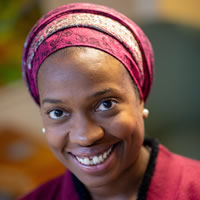
Fatimah Fanusie, Ph.D., ICJS Program Director for Justice Leaders
Fatimah Fanusie is a historian of 19th- and 20th-century American religion whose research is an evolving reappraisal of the study of African American Islam, the modern Civil Rights Movement and Islam in the West. She is also a lecturer in the Islamic Studies department at Johns Hopkins University and a Historian Consultant for the Howard Thurman Historical home in Daytona Beach, Florida. She received her B.A. in History and Arabic from Lincoln University, her M.A. in American History from Tufts University, and her Ph.D. in American History from Howard University.