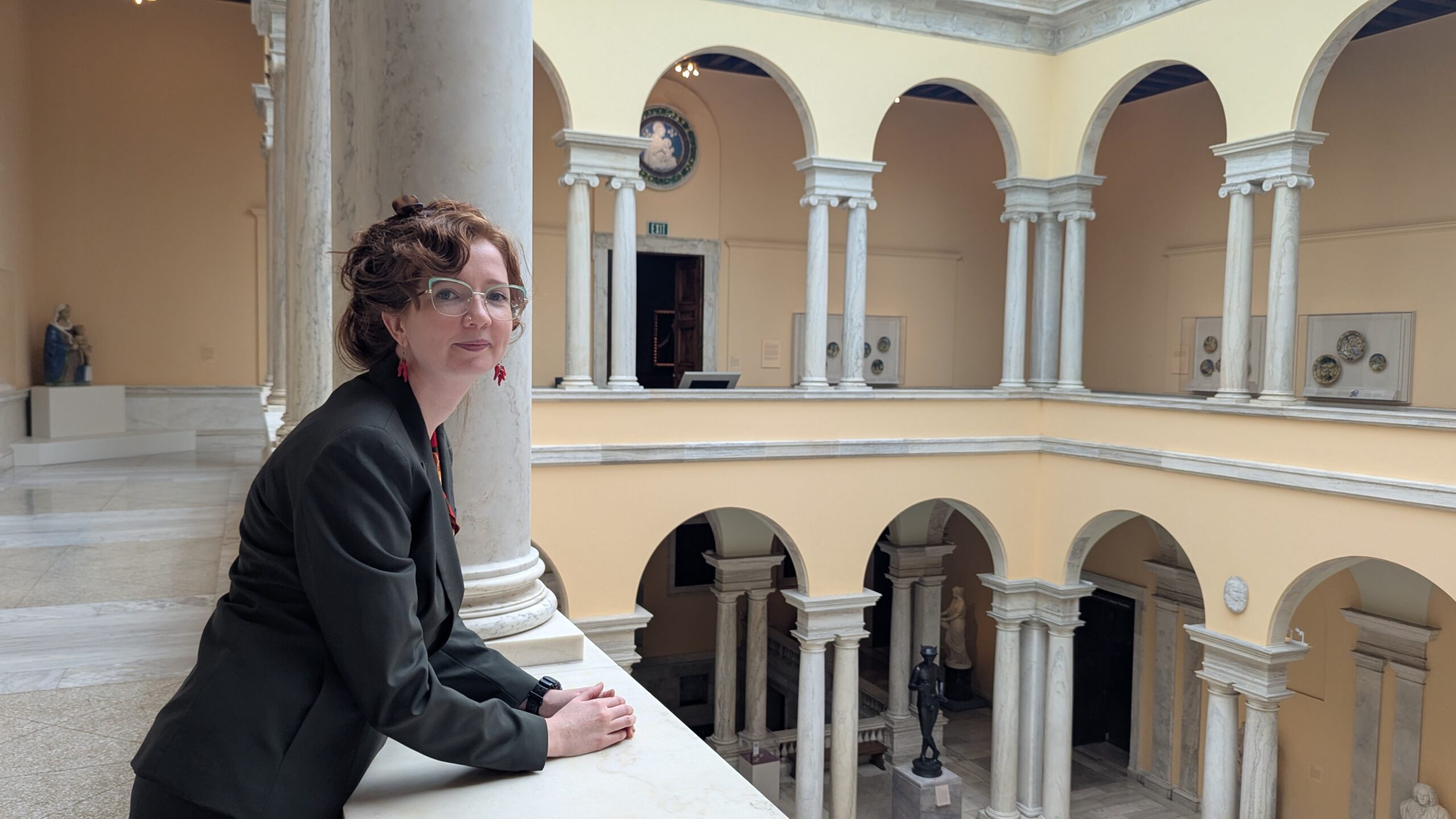
Religion may not be the first thing that comes to mind when thinking about museum education or working in a museum space. But for Elizabeth Norman, assistant manager of gallery experience and interpretation at the Walters Art Museum, religion is an integral part of the museum’s collection.
“The objects that we care for and connect people with across the museum, many of those objects have some connection to religion or faith,” she said.
Norman learned about the Institute for Islamic, Christian, and Jewish Studies (ICJS) from a tour she led for the Fellowship for Teachers, and became interested to learn more about interreligious encounters and dialogue. But she doesn’t practice the religious traditions she was raised in, and thought others might have opinions about her life choices. So it was with great anticipation and some trepidation that she joined the 2025-2026 Fellowship for Nonprofit and Civic Professionals cohort.
“But I found that everyone’s perspectives were respected equally within the process. Everyone was coming from a space of wanting to learn from each other and were so generous with their experience and their perspectives,” she said.
Connecting the dots, expanding the view
Interreligious dialogue is central to participation in the ICJS fellowship. Norman drew direct connections from her museum tour work to her experience sharing ideas and inquiries with her diverse cohort over the course of 10 months.
“Having a place to practice dialogue with people coming from different backgrounds, different organizations, that’s always going to be something that is useful in the museum education space,” she said. “Because [as museum educators] we are always meeting new people, visitors, who we are welcoming into our space and working to create connections with them.”
Another thematic thread in Norman’s fellowship experience came from sharing a space with others to learn, question, and then consider big ideas, allowing them time to sprout and grow.
“Being in a space with people sharing other perspectives, other people’s brains in the room, there’s so much more that we can find through talking together than through our own perspectives alone.”
That expanded way of thinking also resonated with her and echoed back to her work.
“Anytime we get to practice making those connections, to practice thinking deeply with other people, I think that’s also something core to best practices in museum touring. It’s really the idea that a group of people looking at something together can see things that they would not be able to see alone.”
Another tool in the toolbox
Norman draws upon many entry points to engage visitors with a work of art, like historical information, perspective, technique, or materials.
“Having the ability to use religious perspectives as one of those many tools has given me a lot more confidence in the number of ways that I engage with new objects and engage with visitors of different perspectives and different backgrounds,” she said.
Ultimately, Norman said, she brings “a lot more confidence to engaging with objects and artworks that have religious associations, religious imagery, and religious histories baked into the fabric of what they are.”
Interreligious dialogue for all
In almost every session of the fellowship, Norman recalled, they were listening to people’s perspectives and then practiced reflecting them back in a way that feels authentic, respectful, and true to what they were saying.
As a religiously unaffiliated person, Norman didn’t see interreligious dialogue as something she could authentically participate in with the group. But the space felt inclusive of so many perspectives, she said, including religious nones—so that opened a window of possibility.
“Religion can feel like a kind of scary thing and an unpredictable thing to engage with other people about, like there’s a lot of potential for things to go the wrong way,” she said. “But if we are approaching each other from a place of curiosity and wanting to learn more and truly, deeply engage with another person’s perspective, then we can move forward in a space where religion does not need to be excluded fully from the conversation.”
November 2026