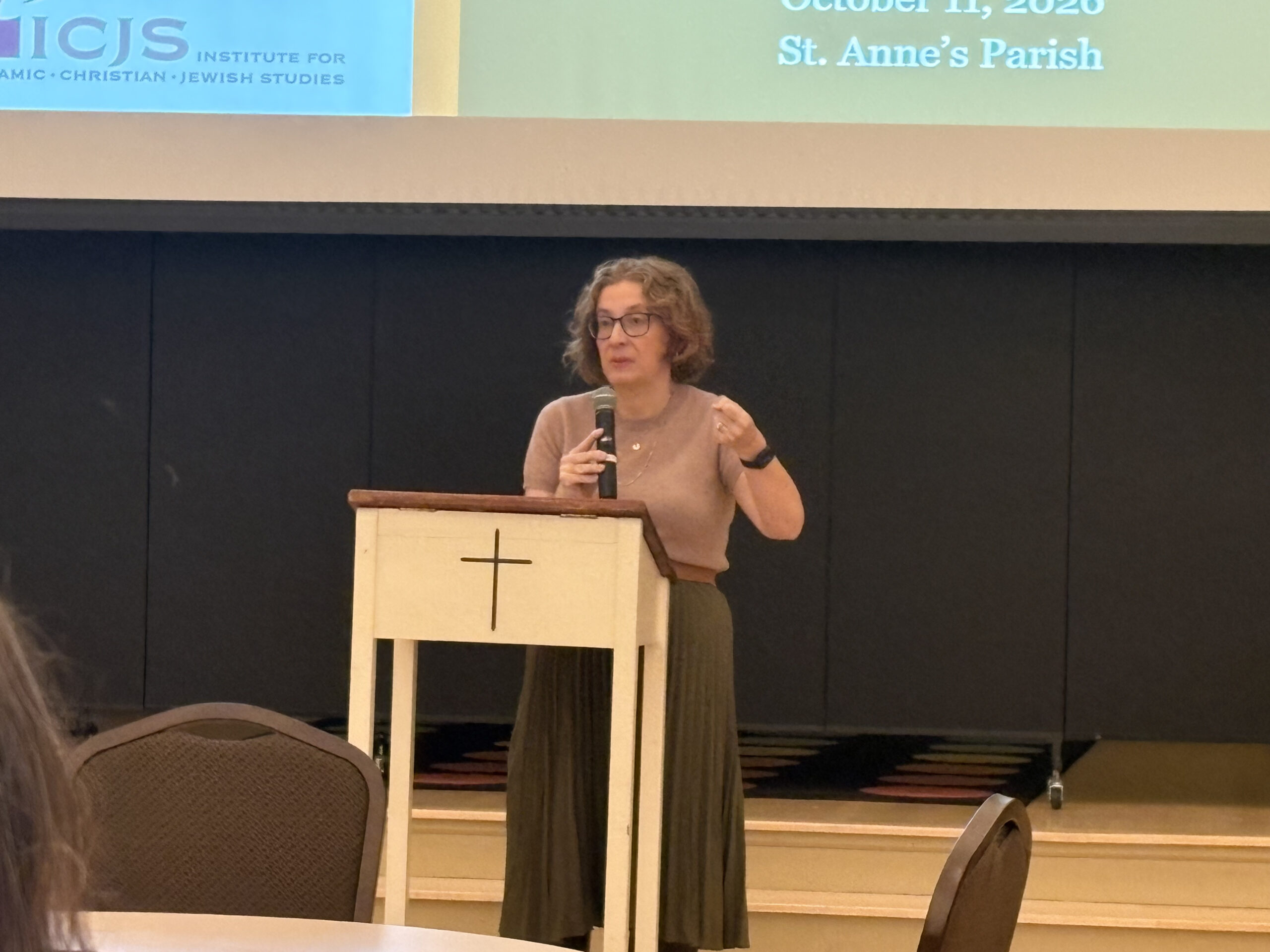
How do we build a shared civic life with neighbors whose religious beliefs and ethical commitments differ from our own? ICJS Executive Director Heather Miller Rubens, Ph.D., explored that question at St. Anne’s Episcopal Church in Annapolis in October, as part of the church’s Church & State Lecture Series.
Her talk, “No Church, No State? Interreligious Experiments in Building a Shared Civic Life,” identified a tension in American civic life: Has our commitment to separating church and state also made us reluctant to discuss the religious beliefs and ethical commitments that shape our communities?
The message resonated at St. Anne’s, whose congregation reflects the varied perspectives of a community in Maryland’s capital, near the U.S. Naval Academy. Its members include active-duty military personnel, veterans, and military retirees.
“We are a ‘purple’ parish with a wide range of opinions across the religious and political spectrum, so it was encouraging to have someone challenge us to find space for honest conversations,” said the Rev. M. Dion Thompson, senior associate. “We hope to take to heart Dr. Rubens’ admonition that avoidance is not an answer.”
Rubens challenged what she calls “Separationism,” an interpretation of the phrase “separation of church and state” that banishes religion from public conversations. This assumption rests on the belief that religious diversity is best managed by keeping religion strictly private.
Avoiding the subject of religious and ethical diversity in public, she argued, leaves us knowing less about what motivates our neighbors, how they make ethical decisions, and what they want for their communities. And it prevents us from seeing our religious diversity as a possible source for civic strength—the wisdom of our religious traditions could guide civic conversations that tackle big problems impacting all of us.
Learning to talk across religious differences is both sacred work and civic work. But it requires practice. It means being able to explain what matters to us while making an effort to understand people whose beliefs and experiences may be quite different from our own.
Rubens encouraged listeners to develop “interreligious ears” alongside their religious voices. That means asking questions rather than assuming we understand, listening for unfamiliar meanings, and letting others explain their beliefs in their own words.
Such conversations don’t require agreement, she said. But avoiding religious differences doesn’t make them disappear. It leaves us less equipped to understand one another and to navigate the challenges of living together in a religiously diverse democracy.
November 2026