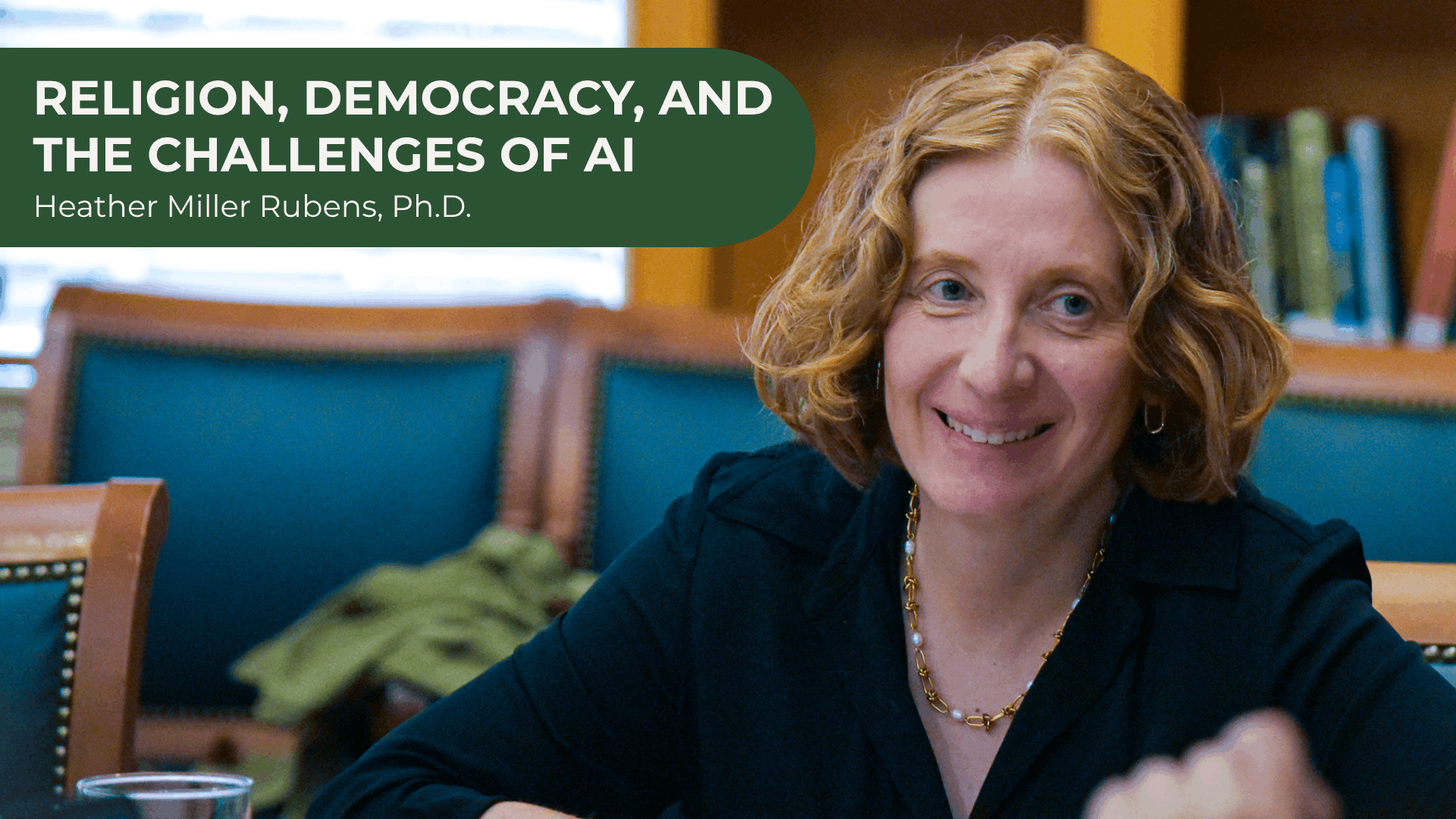
Religious difference is a fact of American life. For Heather Miller Rubens, Ph.D., the more important question is what we do with it: whether difference becomes a source of division or a source of strength for our democracy.
That question runs through two strands of Rubens’ scholarly work this year. In her writing and teaching, Rubens is making the case for a multireligious democracy that treats religious diversity as a civic good rather than avoid the thorny topic of religious difference in building a shared civic life. At the same time, Rubens is the principal investigator leading the development of the ICJS Interfaith Benchmark 1.0, which will rigorously evaluate how artificial intelligence answers interfaith questions.
Rubens’ multireligious democracy essay project, which will debut next spring on Substack, begins with a fundamental tension in American public life: The United States is extraordinarily religiously diverse, yet most people would rather avoid engaging in religion-talk with their neighbors, co-workers, and friends. Why is that the case? And what could we do to better engage our religious differences, especially in civic life? In the United States people of many religions—and no religion—share schools, workplaces, neighborhoods, and political institutions. We can’t avoid our religious and ethical differences if we are committed to building a shared civic life (even if we may want to).
The project examines the dominant frameworks for religious and racial difference, arguing that both Christian nationalism and the separation of church and state, are two very inadequate (if popular) frameworks for approaching a religiously diverse nation, and Rubens considers what new frameworks might take the place of these broken paradigms. Her essay series makes the case for naming a clear goal that we can work towards—namely, a multiracial, multireligious democracy in which religious diversity is understood not simply as a problem to manage but as a civic and moral good to cultivate. The central argument: Building a multireligious democracy requires not less conversation about religion, but more “religion-talk,” as well as greater fluency in talking across religious and ethical differences.
Rubens’ second track takes this exploration of religious difference into the rapidly evolving world of artificial intelligence through the ICJS Interfaith Benchmark 1.0, which is designed to assess how effectively large language models (LLMs) respond to questions involving religion and interreligious difference. In developing the benchmark, ICJS is consulting with social scientists and data scientists at Johns Hopkins University and is in conversation with other researchers examining religion and AI, including the multi-university Consortium for Evaluation of Faith and Ethics in AI (CEFE-AI).
Working on the Benchmark has pushed Rubens back to reexamine some of the most basic interfaith questions: What makes a question an interfaith question? And where, exactly, do bias and bigotry enter the picture? What kind of answers could improve interfaith understanding? What happens when a user asks AI to serve as a supposedly “neutral” third-party commentator and explainer about different religions? What happens when a user asks AI to become an interfaith dialogue partner?
Simply encountering religious difference does not necessarily produce understanding. “Proximity in and of itself doesn’t create respect or understanding,” Rubens said. “In fact, it can often do the opposite. It can create friction and division.” The challenge, she argues, is to think intentionally about how AI might instead create opportunities for understanding, engagement, and dialogue around religious difference.
Much of Rubens’ work this year will involve developing the evaluation rubric and working with expert evaluators to determine what constitutes a strong, nuanced response. The machines can generate answers quickly. The harder work is human judgment.
“The human part is 100% necessary,” Rubens said. “Just because something is efficient and quick doesn’t mean that it’s solid and sound and considered.”