Affirming the dignity of every human being is not simply a moral principle to be professed, states ICJS’ Heather Miller Rubens, but something that must be learned, practiced, and sustained—especially in a world shaped by dehumanization and polarization.
Drawing on Catholic Social Teaching and the work of Pope Francis, Rubens offered a theological account of human dignity on a recent panel that is deeply rooted in tradition and deliberately tested through interreligious encounter.
“I want to offer a kind of Human Dignity 101 in the Roman Catholic tradition, grounded in text,” Rubens explained—one that is shaped by Church teaching, and tested in conversation with others.
Rubens, ICJS executive director and Roman Catholic scholar, presented these reflections in November 2025 as part of an interreligious panel at Jewish Theological Seminary. Her remarks framed human dignity not as an abstract ideal, but as a moral claim with concrete implications for civic life.
Grounding Human Dignity in Catholic Social Teaching
She began by situating her argument within Catholic Social Teaching, the Church’s moral framework for promoting human dignity and the common good in society. Emerging in the 19th century amid industrialization, economic upheaval, and war, Catholic Social Teaching places the life and dignity of the human person at its center.
“Human dignity is core to Catholic Social Teaching,” Rubens said.
To orient an interreligious audience, Rubens offered, what she playfully called her own “Baltimore Catechism” style, teaching on human dignity—posing a series of foundational questions distilled for public conversation. For Catholics, she explained, human dignity is revealed through scripture, particularly Genesis 1 and the belief that all human beings are created in the image and likeness of God. It is also articulated and developed through Church teaching as it responds to new historical realities, including through interreligious encounters.
At the heart of Catholic Social Teaching is the conviction that human dignity applies to everyone, everywhere, and all the time. “The Catholic Church understands human dignity as inherent and non-contingent,” Rubens said. There is nothing—poverty, trauma, suffering—that can take it away. While human beings can betray their dignity through sin or by harming others, dignity itself is never extinguished.
Dignity as Inherent—and to Be Realized
At the same time, Rubens stressed that “human dignity isn’t simply a status; it’s something to be realized,” she said. “Creating spaces for human flourishing is important for upholding human dignity.”
From this foundation, Rubens traced the development of dignity through key texts of Catholic Social Teaching. She began with Rerum Novarum (1891), Pope Leo XIII’s landmark encyclical on labor, which insisted that workers must never be treated as mere instruments of production and affirmed the equal dignity of rich and poor, ruler and ruled. She also noted the significance of the 1948 Universal Declaration of Human Rights, after which the language of dignity gained renewed force in both religious and secular moral discourse.
Turning to the Second Vatican Council (1962–1965), Rubens highlighted three themes that continue to shape Catholic engagement today: conscience, freedom, and religious diversity. Gaudium et Spes described conscience as the “inner sanctuary” where each person encounters God. Dignitatis Humanae articulated a robust defense of religious freedom grounded in human dignity, while Nostra Aetate affirmed interreligious dialogue as essential not only for understanding, but for confronting bias, bigotry, and harm.
From Family to Friendship: Pope Francis’s Relational Vision
From there, Rubens moved to the heart of her argument: Pope Francis’s reimagining of human dignity for a religiously plural world. Focusing on Fratelli Tutti (2020), Francis’s third encyclical, she described it as a call to the whole human family to build cultures of encounter grounded in dignity and sustained through dialogue. “I think Pope Francis is both saying and showing that interfaith dialogue and collaboration are themselves spaces where we learn about human dignity,” she argued.
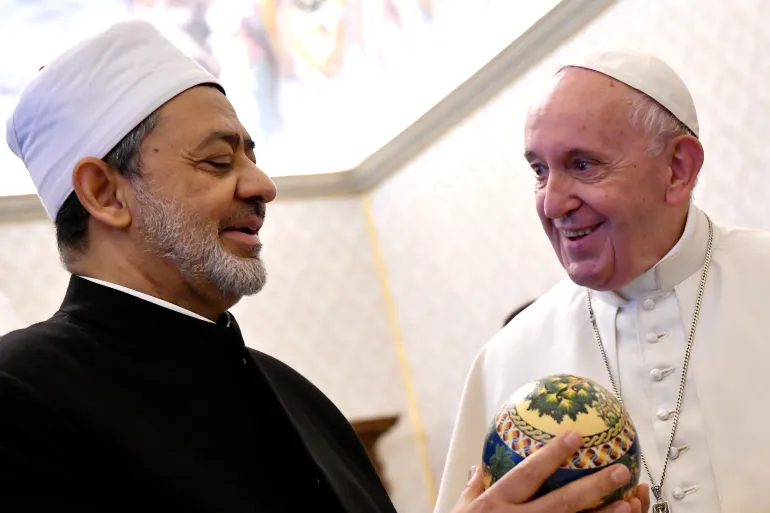
Rubens emphasized that Fratelli Tutti emerged directly from an interreligious friendship between Pope Francis and Grand Imam Ahmad al-Tayyeb of al-Azhar, whose 2019 joint declaration, Human Fraternity for World Peace and Living Together, affirmed that all people are equal in rights, duties, and dignity.
At the center of Francis’s vision, Rubens suggested, is a provocative use of kinship language. Calling humanity “brothers and sisters,” Francis insists on universal moral obligation—without romanticizing family life. Families, he acknowledges, can be sites of betrayal, violence, and exclusion. Yet the question remains unavoidable: Am I my brother’s keeper?
Rubens argued that Francis’ insight lies in distinguishing between family as a given and friendship as a goal.
“What he’s trying to say is that if we make a foundational theological claim that we’re all brothers and sisters, that’s the baseline, that’s where human dignity begins. And if we can affirm that, then we need to work towards friendships,” she said. The telos of this whole project is friendship, and dialogue and collaboration are the path between becoming family to becoming family who are also friends.”
Rubens concluded by returning to the present moment, marked by polarization and dehumanization. Catholic Social Teaching’s view of human dignity remains urgently relevant today.
“I think that Pope Francis and his pontificate have particular lessons that we can use today,” she said. “In this current moment, in a culture of dehumanization, dialogue is a deeply rehumanizing activity, and recognizing that we are all brothers and sisters is, in my opinion, a great place to start.”
Photo: Pope Francis and Grand Imam of Al-Ahzar Ahmed al-Tayyeb, 2019.
December 2025