As a trained community organizer, pastor, and Episcopal priest, I began this fellowship confident in my capacity to listen and in the collective power of listening to move us ever closer to living out God’s vision for a peaceful and just world. What is, after all, God’s command to love God and neighbor in practical terms, if it is not first and foremost a command to listen?
Yet the ICJS Justice Leaders Fellowship was gathering for the first time two days after October 7th. God’s people have always gathered (and will continue to gather) in times of conflict, war, and violence throughout time and all over the world. But a gathering of this particular group of God’s people committed to interreligious justice work in Greater Baltimore felt different. The immediacy of the attacks and the military response to them available in our news feeds, on our phones, unfolding in new horrific detail each day, each hour…how could we speak of anything else? How could we hear anything else? How could we listen?
As a Christian, and a person without immediate family and friends in the midst of the violence in Gaza and Israel, I swung wildly between two poles. On one side, I felt an urgent need to make sense of this senseless war and speak a word of hope and guidance into the Episcopal parish that I lead. On the other side, I felt an urgent need to say nothing, feeling deeply that any words I could say would be a sacrilege, falling far too short from honoring the dead and ongoing human suffering. I took some comfort in the verse from St. Paul in his letter to the Church in Rome that even the Spirit of God prays with us “groans too deep for words” (Romans 8:26).
I would often get stuck in this place as the months rolled by. Then I listened to ICJS Muslim scholar Zeyneb Sayligan, Ph.D., speak about justice from a Muslim perspective. I listened to her presentation, rich and deep with scholarly expertise. What struck me most, though, was her term micro-justice, meaning, as I understood her to say, the daily—sometimes hourly—acts of justice that God invites us into each day simply in living the lives we have been given to lead with the people who God has placed in this precious life we have.
She challenged us to think about these acts of micro-justice: do we notice these opportunities? Do we recognize them as invitations to do justice? How do we respond to God’s promptings do justice on this micro level? Or do we plow through our days, our hours, our minutes, giving God and neighbor simply lip service, listening only on a surface level, if at all, as we move toward our own plans for doing justice, a concept of justice that perhaps has more to do with human pride than with God’s vision for God’s people and all creation? Finally, is justice in God’s terms even possible on any scale other than on this intimate scale—person to person, human being to human being? Listening deeply to one another, connecting deeply, and living it out day by day in the specific communities in which we find ourselves may be the only way to enact justice.
Healing, reconciliation,and the creation and nurture of just and merciful communities are all part of the slow, hard, and life-giving work of following God’s love command, one act of micro-justice act at a time.
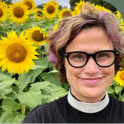 The Rev. Dr. Amy Slaughter is a rector at St. Francis Episcopal Parish & Community Center and was a 2023-2024 ICJS Justice Leaders Fellow. Learn more about the ICJS programs for community and nonprofit leaders here.
Baltimore is part of a national conversation around questions of justice, race, and community. Members of the ICJS Justice Leaders Fellowship consider how Jewish, Christian, and Muslim teachings and practice can contribute to the public conversation about (in)justice. Opinions expressed in this blog are solely the author’s. ICJS welcomes a diversity of opinions and perspectives. We do not seek a single definition of justice between or within traditions.