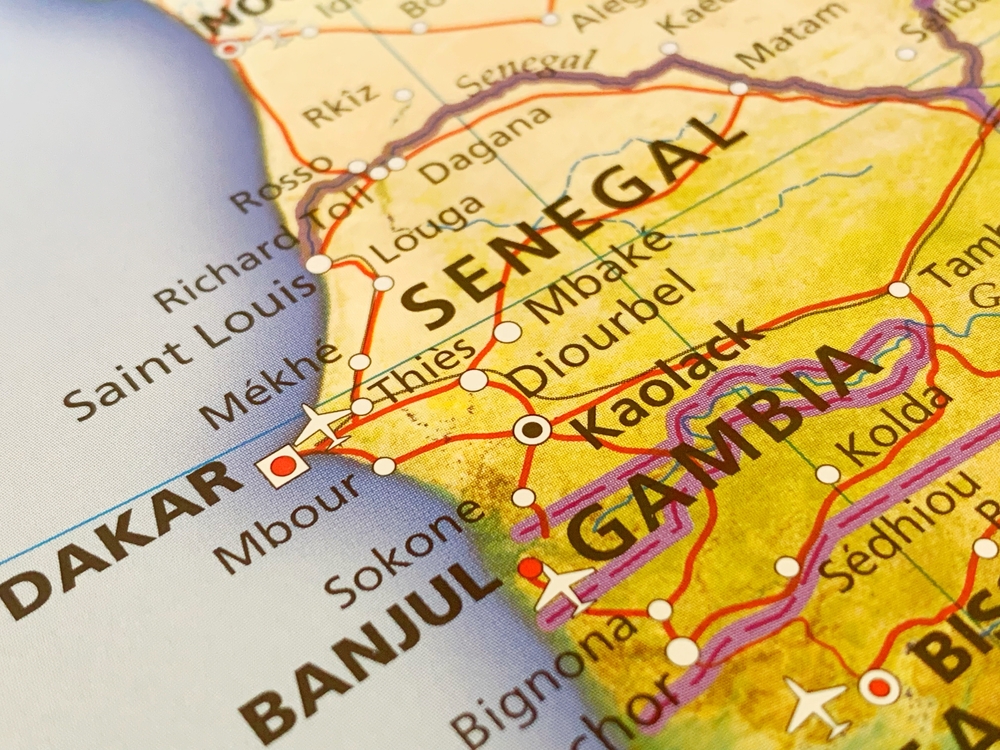
Fatimah Fanusie, ICJS’ program director for justice leaders, has some exciting news. She will be taking a leave of absence from ICJS while her daughters attend a Qu’ran-focused school in Senegal, while she does scholarly research and works on a book manuscript.
The Justice Leaders Fellowship (JLF), led by Fatimah since 2020, will be on hiatus in the 2024-25 academic year. The program will resume in fall 2025.
In this Q&A, Fatimah fills us in about her plans.
Q: This sounds like an amazing opportunity for your daughters. Tell us what they’ll be doing.
One of my daughters will be going into eighth grade, and my other daughter just graduated from middle school and will be transitioning from her Islamic school into a public high school. We wanted to take a short pause in that process. So they were both admitted to a full-time Qur’an school in Senegal. We have quite a few friends in the U.S. whose children have attended the school.
We believe that attending the school will be an important step to the girls’ religious development. The Qur’an is considered G-d’s direct instruction to humankind and so its memorization and regular recital is how Muslims orient themselves to the way of G-d. Memorization is supposed to impact one’s heart with the light of revelation. In the formal Muslim prayer ritual, the imam always recites from the Qur’an, symbolizing how G-d’s word is what leads Muslims in their life. We hope the girls’ study of Qur’an will impact their hearts.
I like the idea of the girls having this global experience before they go off to high school. Even though we are all connected through social media and the worldwide web and it’s made our world more accessible, it also shrinks their world. Teenagers are defined more by their Google chat and whatever is on their device. So we’re really excited to be giving the girls a chance to see more of the world, to realize the privileges that they do have, and to gain other perspectives.
They’ll be going to school five days a week, and I’ll be homeschooling them on the weekends. We’ll also be traveling widely through Senegal and we plan to visit Gambia (which is adjacent to Senegal). We also plan to visit Morocco and Europe before returning to the U.S.
Q: What projects will you be working on during your leave?
While in Senegal I plan to work on my book manuscript, which is based off of the research from my M.A. thesis. It examines the development of Islam in Boston between 1948 and 1968, through the formation of the Nation of Islam’s Temple No. 11 during this period. I’m examining the role of a group of cultural innovators—including bebop jazz musicians, veterans from both World War II and the Korean conflict, and migrants from the South—and how this eclectic and entrepreneurial-minded group of (mostly) men formed the nucleus for Temple No. 11.
I make two arguments in this research and attempt to address a significant void in American historiography. One is that this community planted the seeds of Islamic culture in Boston among African Americans, and the second is that this community also revitalized African American cultural life in Boston. Boston’s development mirrored what happened throughout the country in areas where the Nation of Islam was established.
Another aspect of my book will explore the relationship between this group of African American Muslims and the Muslim community in Quincy Point, the descendants of late 19th century immigrants from the Levantine area, modern-day Syria, and Lebanon. As these Muslim migrants assimilated and integrated into Massachusetts society, they lost many of the Islamic aspects of their culture. So these African American Muslims in North Roxbury actually served as a catalyst for the Muslims of Quincy Point. It was so interesting interviewing descendents of these Arab American Muslims, who talked about how the African American Muslims from Temple No. 11 would attend their functions and exclaim, “Wait, what? You’re gambling? Wait, are you serving alcohol? It’s time to pray. You’re not praying?” And so that was kind of a catalyst to push them into reestablishing their Islamic identity.
This research also examines how historians and scholars of African American 20th century history have neglected the relationship of the Nation of Islam to the Civil Rights movement in America. Traditional scholarship frames African American leadership as moving from an integration-assimilation focus, introduced during the modern civil rights era, to a focus on cultural and economic institution-building. While scholars often discuss this shift as if an unseen hand moved the focus from one to the other, my research argues that the “unseen hand,” through much of the country, was actually the Nation of Islam, which was encouraging institution building and nation building.
Q: You mentioned that you’ll be doing some traveling during and after your stay in Senegal. What are you looking forward to seeing?
The girls actually have family ties in Senegal, and we want to check that out. My husband’s dad is from west Africa and so they have lineage from Senegal in addition to Sierra Leone and Nigeria. One ancestor came from a town called Ndar, known now as St. Louis, Senegal’s former capital.
When we visit Morocco, we plan to take a boat across the Strait of Gibraltar into Spain. My daughters want to revisit Andalusia, where we briefly visited in 2022. They also want to revisit Seville. The thing that we really loved about Seville are the traces of interreligious culture. There’s one quarter that was initially a Jewish quarter and you can see remnants in some of the buildings. But you can also see traces of Islamic and Christian influence. It’s just fascinating to see the Abrahamic faith traditions on the buildings, literally one on top of the other.